Friday, September 24, 2010

Ash & Oak stools and coloring wood with walnut husks


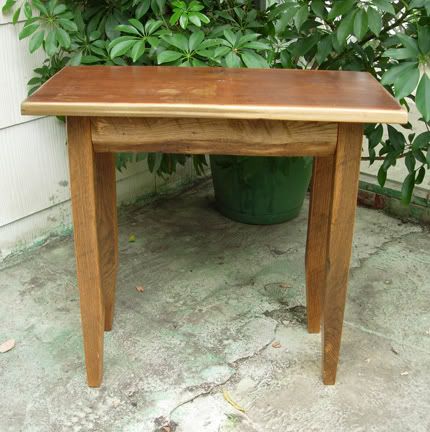
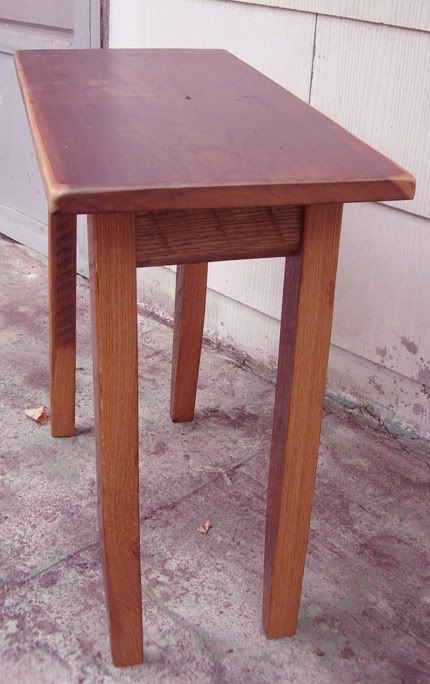
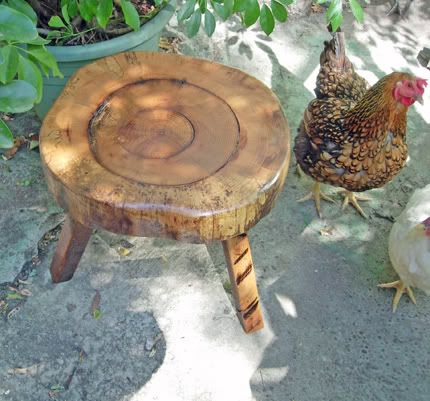
This is one of a pair of ash and white oak stools I did for the 2010 Monrovia fair. I had a bad feeling about the fair before hand and it proved to be so. It was a washout for me. So, I gave this stool to my brother for his birthday.
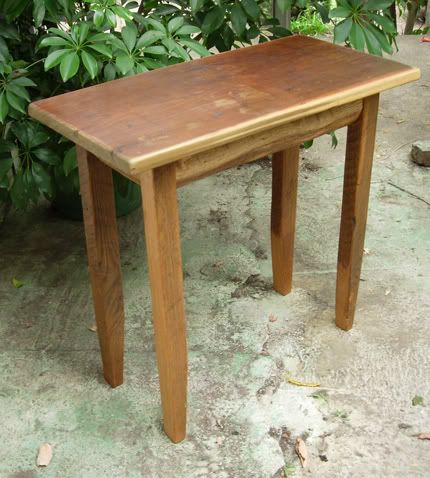
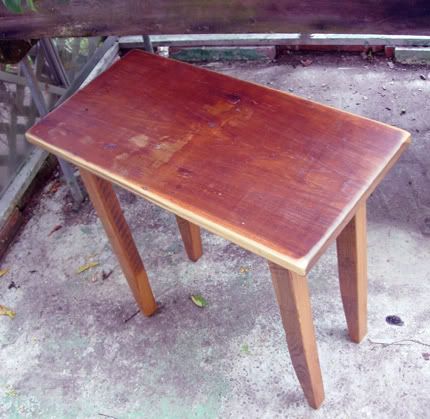
The top is a plate of ash from the same log I did the last set of stools from. I'll probably be able to get a few dozen stools out of it before I'm done. The legs are ripped from a roughsawn white oak 2x4 I salvaged. I only roughly smoothed and shaped them, leaving the major saw marks and signs of wear in place.
Ms Jaunty Beret, one of our gold wyandotte hens, came to supervise my photo session.
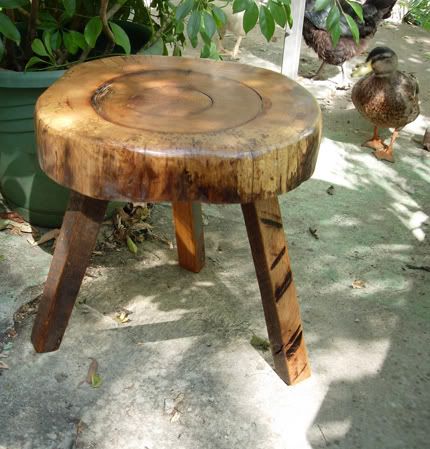
After Ms Jaunty Beret realized I had nothing to eat and left, her place was taken by Quaker Jack the mallard.
This is the same stool from a lower angle to show the legs a bit better. This stool has no stain, but several coats of spar urethane.
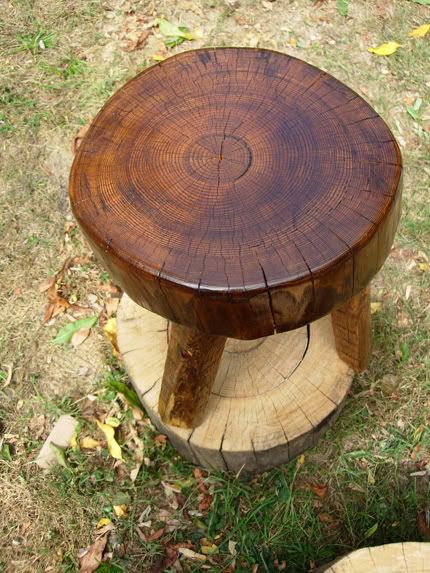
This stool is the one I thought would be interesting to rustic minded readers.

The stool is just like the one above, ash and oak, with a couple differances.
The legs are red oak instead of white. I cut them from an 8' 3x3 I found behind a dumpster in town. Probably from a shipping crate of some sort.

It's about an inch and a half taller than the stool at the top of the post, 18" surface height. This the most common height for dinning chairs.

The most interesting thing is the color though. I used no commercial stain on this stool. Instead I rubbed it directly with the green husks of black walnuts. The juice of the husks produce a powerful stain, and I've tried before to make a liquid stain from them, with limited success. This time I just twisted the husks off the nut and rubbed the juice into the wood by hand.

For the picture, I place the stool on top of a another section of ash from the same log, to show the difference in color between the unstained wood and the husk colored.

At first the stain colored the wood a yellow-green that wasn't so appealing. But I left the stool in the sun for a couple of days and it gradually changed into a very rich nut brown with gold high lights. I'm very pleased with the results.

I'm going to go collect enough walnuts for a big piece now. I'm thinking of a kitchen table. I'm still going to try and render or tincture the husks into a liquid base, but I have the feeling that I just won't get the deep color that hand rubbing with the husks has provided.

Thursday, September 2, 2010

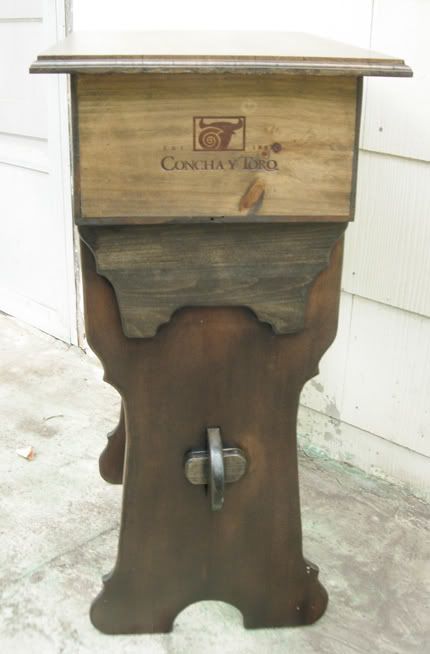
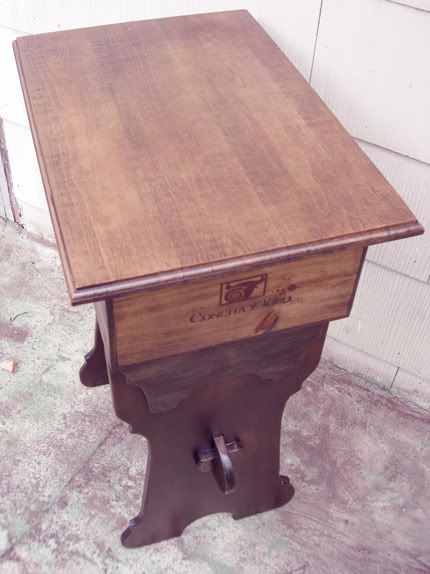
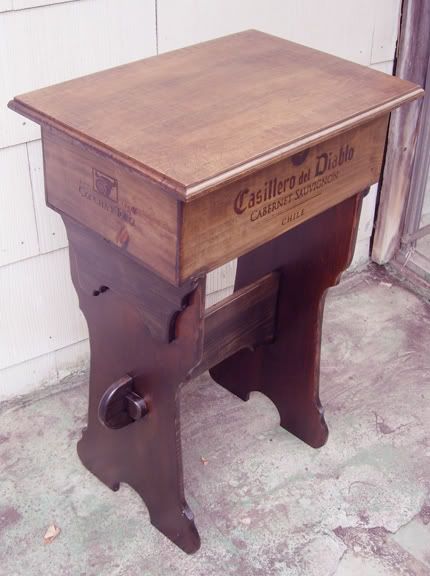
A somewhat gothic wine crate lamp table.


16" wide x 24" long x 34" tall. A lamp table is taller than an end table as it is meant to stand behind or beside a reading chair. It keeps the lamp higher than an end table to shed good reading light down on the book.
They also make good door side tables or entry way tables. You can put a basket or tray on an entry table to keep keys or serve as a catch all.
None of the three photos here quite have the correct color and tone of the actual table. The top and bottom are too light, and the middle is too dark. I used an old can of ebony stain that had solidified, and though I thinned it back to liquid, the change alters the texture and color of the stain.
I like it though. It's much darker than I usually go with, but I think it fits the shape of the trestle legs quite well.

The top is made from an old and scarred maple cutting board. It took a lot of hand scraping with a broad chisel to remove the top layer of surface wood. I didn't want to plane it as I didn't intend to remove all the years of knife scars from it.
I went ahead and routed the edge to dress it up a bit. Maple really works cleanly, the routing is very sharp and defined.
I usually use old pine, poplar or oak for tops and they're much less apt to take a clean edge without a few extra passes.
This is the only crate I had for Cassilero Del Diablo, a Cabernet from Chile. Its shallower than most of the other crates I've collected and gives the table a less top heavy profile. In these pics is looks a bit leg heavy to me, but it doesn't appear so in person. A matter of perspective I suppose.

Wednesday, August 25, 2010

Poplar plank leg table.


The top of this little table is a single piece of tulip poplar that once was a closet shelf in my grandmother's house. The plank was much older than the closet, which was an add-on to a room that was originally built without closets. The underside of the shelf was black with that soft, almost crumbly texture that poplar gets after 90 or so years undisturbed in the dark.

The legs are white oak. I ripped them down from a 2x4 salvaged from a friend's barn. Guess what an 8' white oak 2x4 costs today. You won't be doing any balloon framing with them, I can tell you.
The apron sections that join the legs are also white oak. I don't recall where I got the original piece from. It had a severe wain, the curve in the surface from cutting the plank from the edge of a log. Most of the time wainy lumber gets trashed or ground up for secondary uses, or used as stickers in shipping, but I thought It would look good as an apron with the wain turned down. And it does.


I took some of the bottom six inches of the legs off to make a slight inside taper. This tends to give the table a more visually pleasing look to the feet, and it also makes it stand more firmly. The less actual area of the foot touching the ground, the less likely it is to have any wobble.

The table is 24" tall by 25" long and 12.5" wide. I gave the top a couple of coats of satin polyurethane but no stain. The wood already had so much color and character that stain would have been over kill.
The legs and the apron I gave a single coat of danish oil, and once that dried, one coat of satin poly over that.

I did all cutting, sanding,and assembly on this table in about four hours. Not having to glue up a top or do any mortising for a trestle base made this very fast.
The finishing took a couple days, mostly just in the waiting for the coats to dry really.
The thing is, this is a table that is solid, functional, and richly characterful. It will be useful long after I'm gone, and it took negligable time and effort,(from my point of view). It recycles and reuses materials from before I was born and gives them a second life. I can't imagine why people go to Walmart and trade their money for slabs of particle board faced with plastic wood grain photos when this is possible. When you give money, the earning of which cost you time out of your life which you can never get back, for any shoddy cookie cutter product, you're actually destroying that little bit of wealth. Nobody is ever going to treasure as a family heirloom the $49.99 flatpacked coffee table you got at target.

Friday, June 11, 2010

A poem apropos for the 21st century.

The Purse-seine, by Robinson Jeffers, 1937

.......I cannot tell you
How beautiful the scene is, and a little terrible,
then, when the crowded fish
Know they are caught, and wildly beat from one wall
to the other of their closing destiny the
phosphorescent
Water to a pool of flame, each beautiful slender body
sheeted with flame, like a live rocket
A comet's tail wake of clear yellow flame; while outside
the narrowing
Floats and cordage of the net great sea-lions come up
to watch, sighing in the dark; the vast walls
of night
Stand erect to the stars.

Lately I was looking from a night mountain-top
On a wide city, the colored splendor, galaxies of light:
how could I help but recall the seine-net
Gathering the luminous fish? I cannot tell you how
beautiful the city appeared, and a little terrible.
I thought, We have geared the machines and locked all together
into inter-dependence; we have built the great cities; now
There is no escape. We have gathered vast populations incapable
of free survival, insulated
From the strong earth, each person in himself helpless, on all
dependent. The circle is closed, and the net
Is being hauled in.......

Tuesday, February 2, 2010

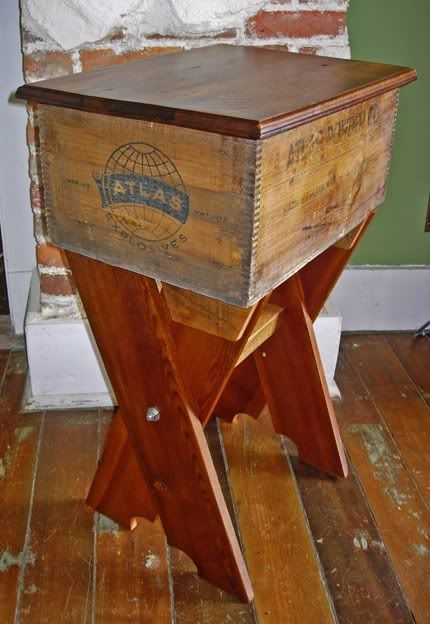
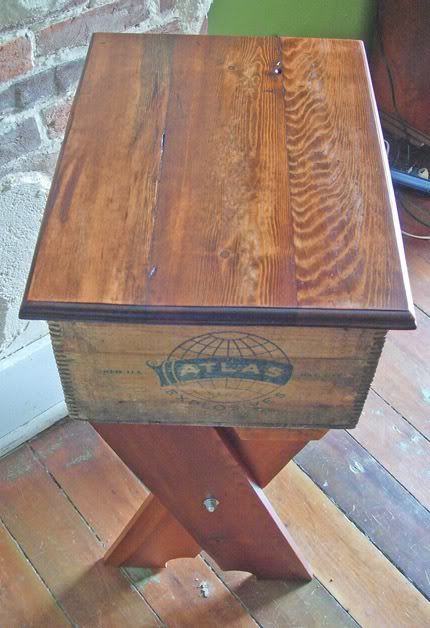
Dynamite Crate Lamp Table.

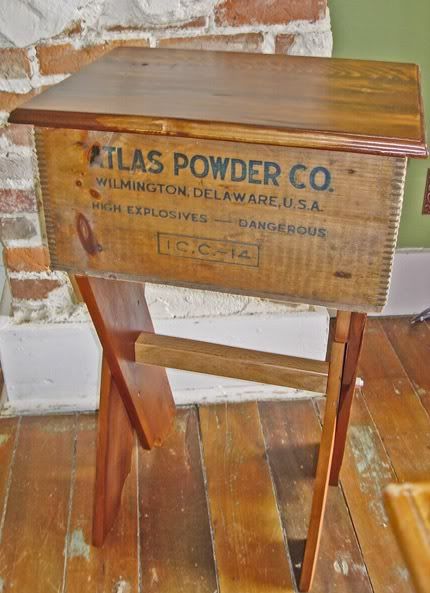
Dad found me this old Atlas Powder Company crate at a flea market a while ago. I knew I'd make a table out of it, similar to the Wine Crate end tables I've been doing.
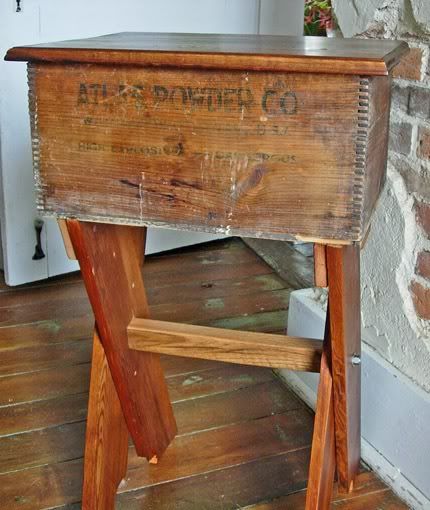
I finally settled on a scissor leg design, with a trestle bar.
I wanted this to look both somewhat rustic, and a bit industrial at the same time. I was going for a look that felt as though it might have been assembled out of available materials at an exploratory mining encampment some time in the past.
To support that theme, I went with exposed nuts and washers on the outside of the cross legs, instead of the mortise and tenon joint I used with the wine crate tables. Since the legs overlap each other, I couldn't use the single broad cleat to hold the legs to the bottom of the crate. Instead, I made a pair of chevron shaped cleats for each end and attached them so that one would be seen from the outside, and the other would be hidden by a leg.


All the parts of the lamp table are salvaged material. The top and legs are made from very old pine planks from a set of shelving my grandmother used to hold homemade jelly and preserves in her basement. The growth rings in these boards are so tight and so numerous, that I can't count them. I suppose I could with a magnifying glass and a stylus, but it would take a while.
You just can't find wood like this now a days. Rings like this indicate a very slow growing and very old tree. We largely wasted the old growth forests of north America on frivolous crap that chokes the land fills now. But I suppose that's a rant for another day.
I gave the top a coat of Minwax Provencal stain, a medium dark and my personal favorite. I them sanded most of it off after it had dried. I purposely took off more stain in some areas than in others, to increase the variation in the appearance of the top.
I really prefer the hand made look to furniture, and most other things really. I like it to the point of leaving dings, scratches and other damage in old materials so that they are obvious in the furniture I make from them.
I sold high end furniture for a long time, and I eventually realized I didn't much care for it. I think it's a problem that our culture of mass manufacture has made people intolerant of imperfection, and unable to appreciate the individual character of things that are made one at a time.
Mass production makes items available to greater numbers of people at a reduced cost, but it also reduces the value of the items produced. Nobody cares about the coffee table they got at Target, there's a million others just like it getting chucked in dumpsters when their badly designed joints give out.
Sorry, ranting again. Heh...
Anyway, I gave the top a few brushed coats of satin polyurethane, so that it would wear better. The powder box itself, I only gave a single thin sprayed coat. I wanted it to retain all of it's worn and faded appeal and remain distinct from the top and legs. The legs got two brushed coats as well.

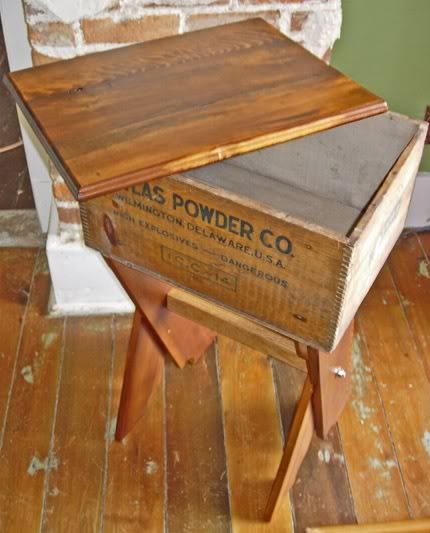
As with the wine crate tables, the top comes off so that the crate is available for storage.

The end of the crate is marked with "50, 4x16, Atlas Apex C, 15, 516, H.V.", I know the 5o means 50 lbs, and I assume the 4x16 refers to the size of the sticks of explosive the crate contained.
I haven't been able to find an identical crate online. Atlas made explosives for a variety of applications, but most of the crates I've seen were for coal mining explosives like Coalite. I know they ceased operations in the 60's, but from the condition of the crate, I believe it at least dates from the 40's.
If anyone can identify the age of the crate more accurately, I would appreciate hearing from you.


Wednesday, September 16, 2009

The Monrovia Festival, 2009

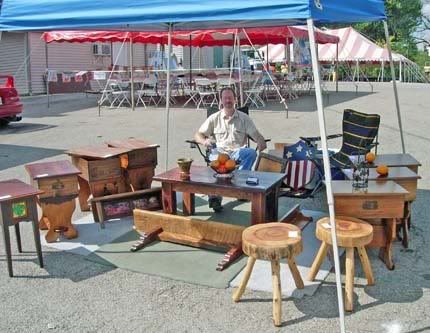
I got a little booth at the Monrovia Festival this year. Above is a pic of me and my display. I wasn't really sure that what I have to offer would go over well. A town festival isn't usually the sort of venue that people go to to look for furniture. Especially my own sort of one-off designs.

The whole thing turned out much better than I expected, however. I sold several pieces when I was really just hopeful for a couple of sales. I had to print more business cards as we went through what we had the first day.

The attendance was much larger than I expected, or remembered from previous years. I'm getting the feeling that people are choosing to attend smaller, local events like the Monrovia Festival, rather than drive farther, and spend more money at larger, events, or on travel and vacations. It seems that the failing economy is likely to force a re-invigoration of local economies and small scale crafts, as world-spanning businesses and supply chains become less viable.
This suites me just fine.
I also think that when people choose to spend their money, they will more and more pick items which are of higher quality, are unique, and will hold their value. I may just be projecting my wishes on the world here, but, I think, in an economy that is reality-based, and not a castle-in-the-sky of financial fantasy, long lasting items with character will have an edge over the mass-produced non-working replicas of real products which fill the bigboxes now.

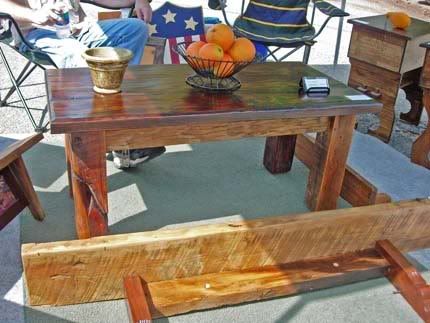
Here is a coffee table and mantle shelf I brought to the Festival. Both are from salvaged materials.
The coffee table is poplar,(top and apron), cedar and ash,(legs). Legs are an interesting find. They were cut from 4x4 beams that served as floor joists in a little barn that was torn down, and then dumped at the home of a friend of mine. He was just going to use the wood in a bonfire for a party, but he let me rummage through it first, knowing I love to salvage useful things, and I pulled out four beams. Three cedar and one ash.
the ash is pale and pretty straight, but the cedar is wainy and had lots of old checking and fractures. As soon as I cut it, it filled the shop with the scent of cedar oil, even though it's who knows how old.

The Mantle Shelf is white oak, and walnut, also an interesting story. The shelf itself was once part of a door frame in my basement, easily cut 160 years ago. I had to pull out the frame last fall to get the new furnace in. We also had to widen the opening in the wall, so the old frame couldn't go back.

In the pic, you can see the shallow curve of the saw blade that cut the plank in the first place. When I get some thing that proves the age and character of a piece of wood, I never take all of it off in the refinishing process. I love that sort of thing.

On the right end of the shelf, which you can't see in the picture, there is a large iron spike that was driven in to the door frame at some time. I don't know what for, but it looks great, and it's nearly impossible to get something like that out of old oak, so I left it in.

The corbels that support the shelf are walnut, and pieces I salvaged from the remains of a very old player piano. Just how old that piano was, I don't know, but most of it had collapsed into dust when I took it apart.


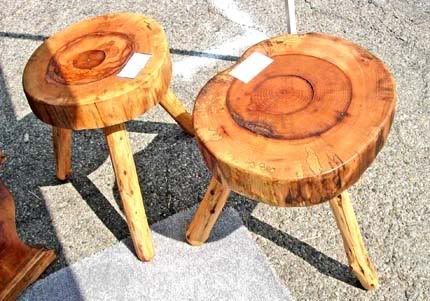
Here is a pair of tables/stools made of ash and cedar. Ash tops and cedar legs. The ash is from a downed tree back in the woods. It came down three years ago, and I'm pretty sure the ash borers are to blame for it's death. I'm seeing quite a few dying ash trees on the property now.

A log of that size, parts of it are more than two feet in diameter, needs a few years to dry out enough to be stable for furniture building. There was still some checking that appeared after I cut some plates for the tops, but I doubt it will cause any problems down the line.
The legs are from a standing dead cedar that was near by. It had been out competed for sunlight under the forest canopy and was already nice and dry. Also, the cedar oil is a great rot inhibitor.
I used an antique draw knife belonging to a friend to shave the legs down to a diameter for the tenons that plug into the mortises in the undersides of the plates. I had to use my clamping table to hold the legs while I shaved them, and it was a pain in the neck. Building a proper shaving horse for the shop is definitely on my too-do list now.

Friday, August 28, 2009

Platform bed on casters.

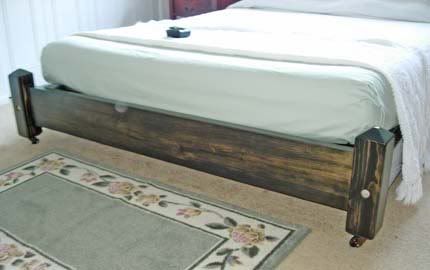
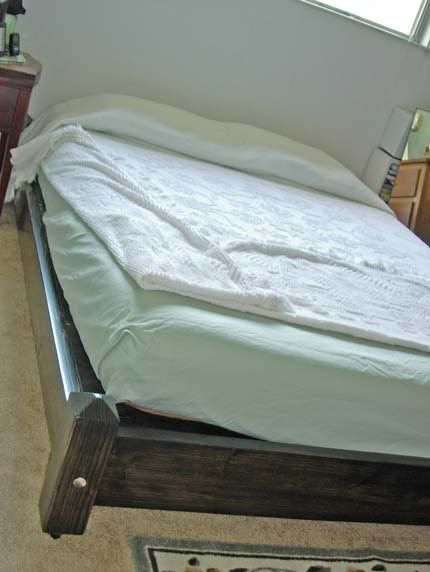
This is a platform bed I built just a little while ago for my Mother-in-law. She had just got a new queen mattress, and since her old bed was a double, needed a new frame.

She wanted the bed to be low, with no box spring, so we went with a platform design. She also wanted to be able to move it around without too much trouble, so, the casters.

To keep the cost low, I built it out of standard dimensional lumber. It has a headboard, footboard, side rails and a plywood platform with extra support feet in the middle.

I used the through-bolt system for the attachment points. Each side rail has a long threaded bolt centered in the end, and a wood dowl above and below it. The bolt enters the end post of the head and foot boards and is pulled tight with a washer and nut from the out side. In the pics you can see the hole for the nuts in the corner posts. I usually cover these with a brass rosette, but I forgot them when we took the bed up.

Around the inside of the headboard, footboard, and side rails is a 1x2 support strip for the edge of the platform to rest on. The platform is in two pieces, so that I didn't have to wrestle a queen size sheet of plywood up to the third floor.

A center support runs up the middle of the bottom of the platform, and four posts support it to ensure that there is no bowing.

The stain is minwax Ebony, with a finish of four coats of satin polyurethane. The weather was hot and sunny when I was finishing this bed, and I like to use the sun to "bake-on" each coat of finish.
I set up a pair of ladders in the back yard and ran plywood sheets through them so as to hold the pieces up facing south. I like to make sure the finish is thoroughly mixed and warm and thin before applying it. It also helps if the wood is warm as well. This gives you a nice even coat that doesn't harden too soon.
I also sand lightly between coats, the end product has a much smoother feel if you take the time to do it right.
A final hand rubbing with a sheet of corrugated cardboard, ripped into two sheets, gives you just enough abrasion to bring up a nice shine.

This bed will break down easily for transport with a ratchet and socket with an extension. In use, you will find that a bed put together like this, instead of the more common hook and eye type connection, is rock solid. This bed does not creak, wiggle or bow. If at any point in the future, wood shrinkage loosens the joints, a half-turn on the nuts will pull it up snug again.